Email triage is one of the most relentless challenges in SOC operations. Qevlar is on a mission to remove the burden of repetitive tasks away from analysts so they can focus on security engineering. The key to being entrusted with that responsibility is human level accuracy, or better.
Between January 1st and January 31st, 2025, Qevlar AI was tested alongside expert analysts at four major organizations—including a Fortune Global 500 enterprise, a critical European infrastructure provider, and two of the region’s leading MSSPs. The AI autonomously investigated 5,000 real-world email alerts that had already been reviewed by human analysts.
The goal: measure Qevlar’s ability to autonomously classify suspicious emails and benchmark it against SOC analysts under real operational conditions.
The Results
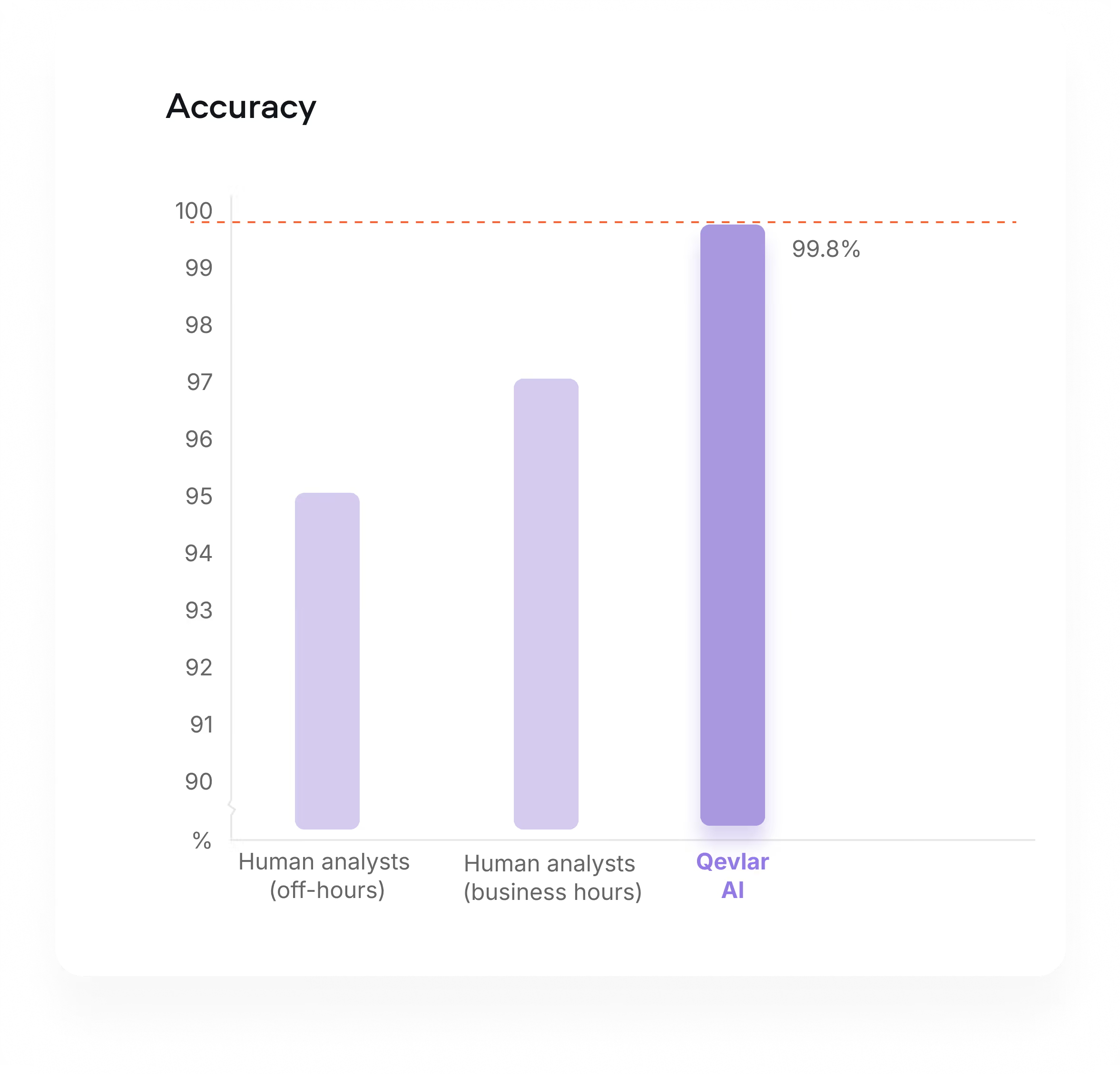
Accuracy
- Qevlar AI: 99.8% accuracy
- Experts: 97% accuracy during business hours, dropping to 95% after hours
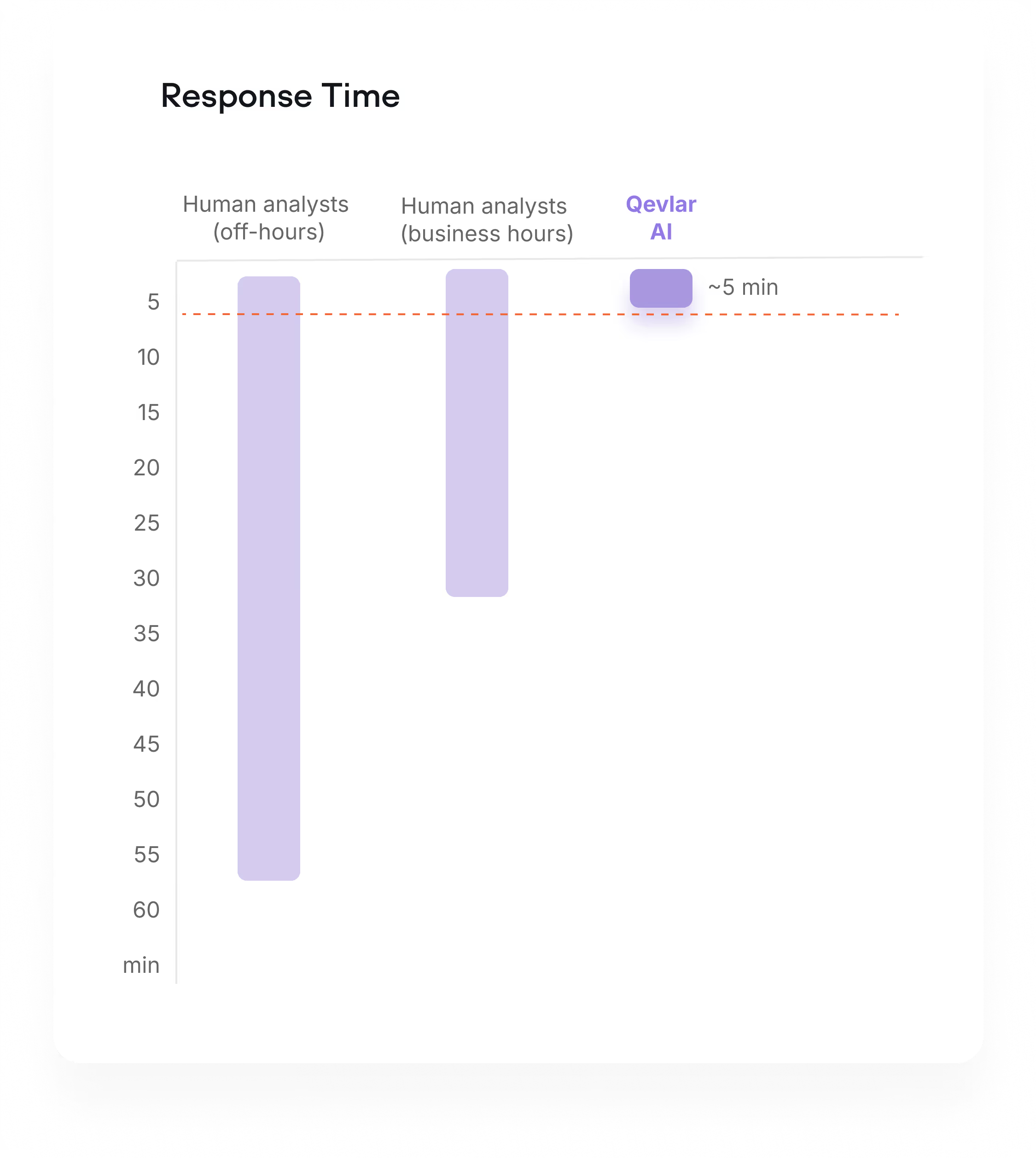
Response Speed
- Qevlar AI: ~5 minutes per investigation, 24/7
- Experts: 32 minutes during business hours, rising to 61 minutes off-hours
Coverage
- Qevlar AI reviewed every alert. Human teams, due to workload spikes and off-hour gaps, left 10% of alerts completely unanswered.
Eliminating Triage Bottlenecks
This was not a small test. Qevlar AI’s architecture scales from 5,000 to 50,000+ investigations per month without a drop in accuracy, speed, or coverage. While human teams battle fatigue and backlogs, Qevlar ensures every alert gets processed—without trade-offs.
Early adopters report:
- Immediate triage reduction – less time spent on repetitive cases
- Higher accuracy – near-zero misclassifications
- Minimal IT overhead – plug into existing SOC workflows
Misclassification Breakdown
Experts
- False positives (4%) – Often triggered by superficial flags (payment mentions, suspicious URLs).
- False negatives (2%) – Usually from over-trusting familiar service providers.
Qevlar AI
- False positives (0.3%) – Primarily in cases where threat intelligence is incomplete or inconsistent. Qevlar AI is biased toward caution, favoring a "better safe than sorry" approach in ambiguous cases.
- False negatives (0.1%) – Mostly reconnaissance emails lacking explicit business context.
Qevlar Gives Analysts an Edge
Qevlar is built to support and accelerate SOC analysts—not replace them. Automating repetitive, error-prone email investigations allows analysts to focus on complex, high-impact threats that demand human expertise.
Even the best analysts can’t maintain perfect accuracy 24/7. Fatigue, workload, and alert overload create gaps. Qevlar AI eliminates those gaps by:
- Scanning every alert with relentless consistency
- Leveraging real-time threat intelligence and behavioral analysis
- Handling the repetitive, error-prone investigations analysts shouldn't be wasting time on
Plug-and-Play Deployment
Integrating Qevlar is straightforward:
- Forward suspicious emails directly to Qevlar AI
- Seamless API integration into your existing SOAR
- Autonomous collection of alerts from your environment
Visualizing the Impact
To make this crystal clear, two simple charts:
The Bottom Line
Leading SOC teams are already shifting to AI-driven triage. Those who don’t will struggle to keep up. Qevlar AI delivers:
- Near-perfect accuracy
- Real-time speed
- Unmatched coverage
- Unlocked human capacity
If your SOC is still battling email triage bottlenecks, it’s time to experience what automation done right looks like.
Let's talk.